Overview.
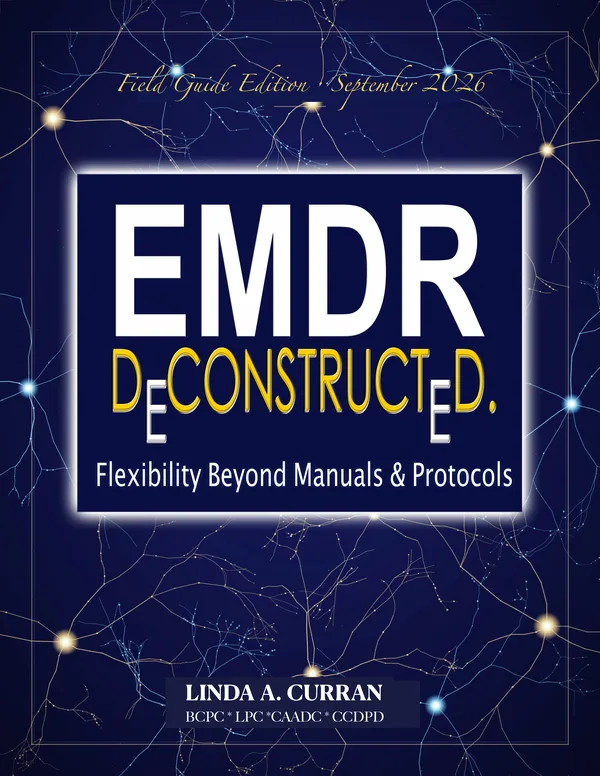
EMDR is an arrangement, not an invention. Its parts ~ bilateral stimulation, dual attention, systematic desensitization, resourcing, interweaves ~ predate the protocol and work outside it. What was assembled can be taken apart.
This book is for two clinicians. The first is any clinician, EMDR-trained or not: the eight components here are basic clinical tools, not Shapiro's intellectual property, usable inside whatever modality you already practice. The second is the EMDR-trained clinician whose highly dissociative complex-trauma client becomes destabilized with the standard protocol ~ the clients EMDR was never tested on, for whom modification becomes clinical risk management.
One toolkit, used two ways: as components inside your own therapy, or as modifications for the clients the standard protocol wasn't built for. For mental health professionals.
Table of Contents.
- 1Introducing EMDR Deconstructed™: Flexibility Beyond Manuals and Protocols
- 2Dissociation and Complex Trauma: Comprehensive Assessment and Strategies for Modifying Treatment
- 3Processing Trauma with Dissociative Clients: Modified Phase 4 and Beyond
- 4Enhancing Resilience: Integrating Imaginal Resources with Behavioral Rehearsal
- 5Transforming Compulsive Behaviors: Flexible Interventions with EMDR
- 6Attachment and Trauma: Relational Styles and Interventions for Each
- 7The Gestalt of EMDR: Integration Through Authentic Presence
- 8Piecing It Back Together: The Complete Architecture
Get the workbook.
One-time purchase. After payment the full workbook is available as an instant download from this page, tied to your account ~ come back any time to download it again.
A print edition is in production with a publisher ~ separately edited and formatted, so it won't match this PDF page for page. This is the Field Guide Edition, August 2026.
© Linda A. Curran, BCPC, LPC, CAADC, CCDPD. All rights reserved. For individual clinician use.
Free chapter: Dissociation and Complex Trauma.
Chapter 2 is the assessment chapter ~ the comprehensive screening-and-strategy material for modifying treatment with dissociative and complex-trauma clients. It is free to download and share with colleagues.
What it covers.
What you get in print that the site doesn't give you: printable client worksheets for between-session use, the stall decision tree (what to do when processing stops moving), session-language scripts in clinical sequence, and the full Chapter 5 compulsive-behavior and addictions protocol.