Linda A. Curran, BCPC, LPC, CAADC, CCDPD.

Linda A. Curran is a licensed psychotherapist, international speaker, author, and consultant with over 20 years of clinical experience specializing in trauma treatment. She holds a Master of Public Health and a Master of Science in Clinical Psychology from West Chester University, where she graduated Magna Cum Laude. She is Board Certified as a Professional Counselor and holds multiple advanced certifications, including Certified EMDR Practitioner / Instructor, Certified Gestalt Therapist, and Certified Co-Occurring Professional Diplomate. Her clinical expertise focuses on complex trauma and dissociation, sexual trauma, self-injury, and personality disorders. Since 2008 she has maintained a private practice, Integrative Trauma Treatment, LLC, where she provides individual and group consultation while developing evidence-based training programs for mental health professionals.
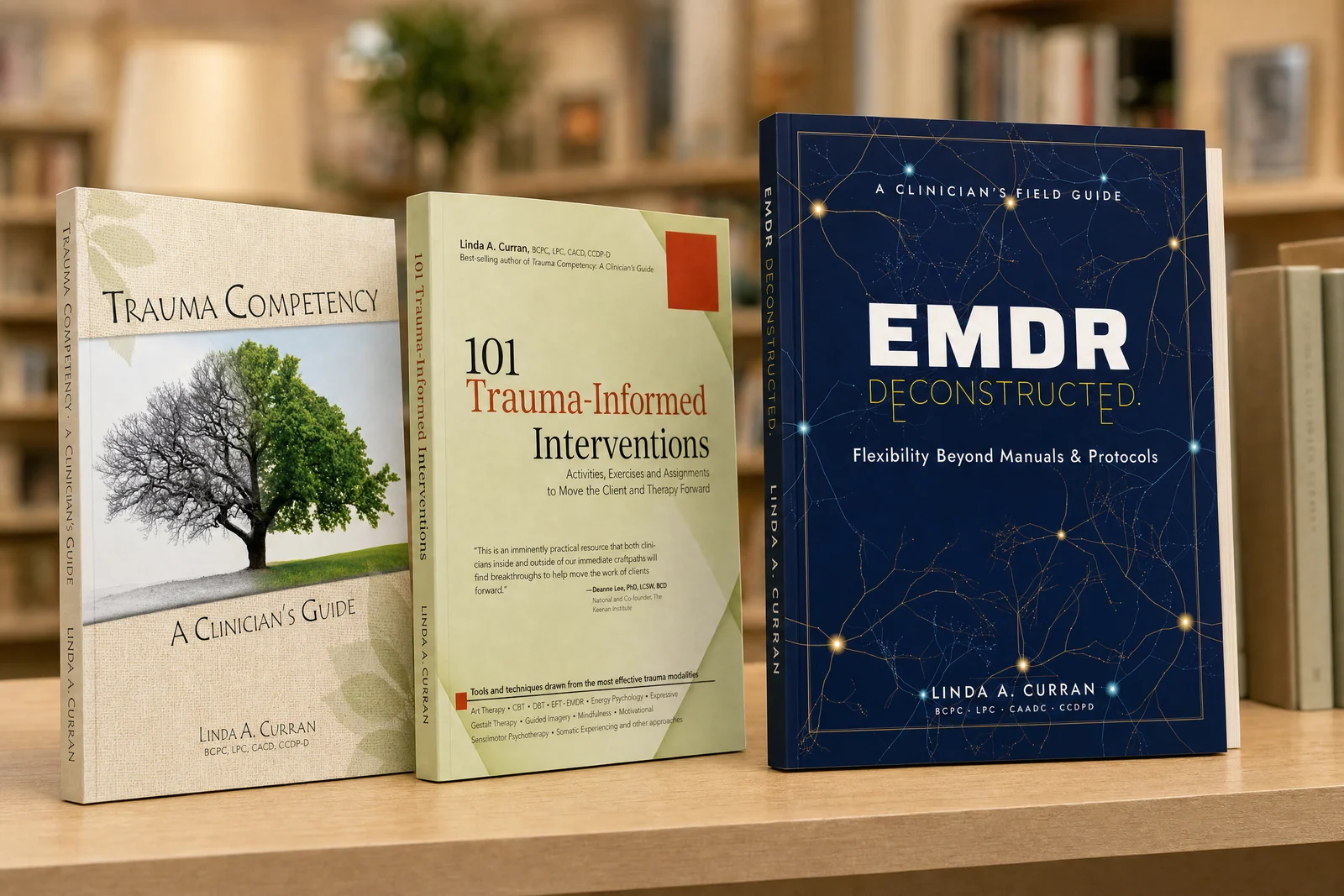
She has published two books ~ Trauma Competency: A Clinician's Guide (2010) and 101 Trauma-Informed Interventions (2013) ~ and has produced eleven video training programs in The Master Clinician Series for PESI Publishing. As a sought-after speaker since 2006, she has delivered workshops on trauma competency, EMDR, PTSD treatment, and personality disorders through PESI, Cape Cod Institute, and numerous healthcare organizations. She currently serves on the Advisory Boards of the International Association of Trauma Professionals and Evergreen Certifications, and is an active member of the Association for the Advancement of Gestalt Therapy. Her most recent work focuses on psychedelic-assisted psychotherapy and advanced somatic approaches to trauma treatment.
- Board Certified Professional Counselor (BCPC)
- Licensed Professional Counselor (LPC)
- Certified Advanced Alcohol & Drug Counselor (CAADC)
- Certified Co-Occurring Disorders Professional Diplomate (CCDPD)
- Certified EMDR Practitioner / Instructor
- Certified Gestalt Therapist
- Certified Hypnotherapist
- Complex trauma & dissociation
- Sexual trauma, self-injury, attachment wounds
- EMDR & body-based / bottom-up modalities
- Integrative trauma treatment
- Clinical training, supervision & consultation
- Psychedelic-assisted psychotherapy (current focus)
About this site.
EMDR Deconstructed is a working clinical reference, not a marketing site. It exists because the question clinicians most often bring to consultation isn't "how do I do the protocol?" ~ it's "what do I do when the protocol doesn't fit?"
The clinical material on this site is drawn from Linda's 7-Day Online EMDR Training Manual (2026) and the EMDR Deconstructed Workbook. The manual is the source-of-truth for clinicians enrolled in the training; the workbook is the print companion to the site.
Consultation.
Case consultation, supervision, and EMDR training ~ live, virtual, or recorded ~ for clinicians working complex trauma and dissociation.
Key meta-analyses.
The four papers cited on this site for evidence-base claims, hosted here so clinicians can read the source material rather than the headline. PDFs open inline in the browser.
- 01Cuijpers, P., van Veen, S. C., Sijbrandij, M., Yoder, W., & Cristea, I. A. (2020). Eye movement desensitization and reprocessing for mental health problems: a systematic review and meta-analysis. Cognitive Behaviour Therapy, 49(3), 165–180.DOI: 10.1080/16506073.2019.1703801
76 trials. EMDR vs control g = 0.93. Only 4 of 27 PTSD studies low risk of bias; the EMDR-vs-other-therapies edge disappeared in the low-risk-of-bias subset.
Open PDF - 02Wright, S. L., Karyotaki, E., Cuijpers, P., Bisson, J., Papola, D., Witteveen, A., et al. (2024). EMDR v. other psychological therapies for PTSD: a systematic review and individual participant data meta-analysis. Psychological Medicine, 54(8).DOI: 10.1017/S0033291723003446
Individual-participant-data meta-analysis. 8 trials, N = 346. No significant difference between EMDR and other psychological therapies on symptom severity, response, remission, or dropout.
Open PDF - 03Karatzias, T., Murphy, P., Cloitre, M., Bisson, J., Roberts, N., Shevlin, M., et al. (2019). Psychological interventions for ICD-11 complex PTSD symptoms: systematic review and meta-analysis. Psychological Medicine, 49(11), 1761–1775.DOI: 10.1017/S0033291719000436
The only dedicated meta-analysis on ICD-11 CPTSD. 51 RCTs total; only 4 EMDR trials, rated low quality. Childhood-onset trauma associated with poorer outcome across modalities.
Open PDF - 04Karatzias, T., & Cloitre, M. (2019). Treating adults with complex posttraumatic stress disorder using a modular approach to treatment: rationale, evidence, and directions for future research. Journal of Traumatic Stress, 32(6), 870–876.DOI: 10.1002/jts.22457
Argues that the heterogeneity of CPTSD presentations is itself the case for modular, individualized treatment rather than a single fixed protocol.
Open PDF
Bibliography.
Selected references for the clinical content on this site. Not exhaustive.
- 01Shapiro, F. (2018). Eye Movement Desensitization and Reprocessing (EMDR) Therapy: Basic Principles, Protocols, and Procedures (3rd ed.). Guilford Press.
- 02Herman, J. L. (1992 / 2015). Trauma and Recovery: The Aftermath of Violence ~ From Domestic Abuse to Political Terror. Basic Books.
- 03Knipe, J. (2018). EMDR Toolbox: Theory and Treatment of Complex PTSD and Dissociation (2nd ed.). Springer Publishing.
- 04Forgash, C., & Copeley, M. (Eds.). (2008). Healing the Heart of Trauma and Dissociation with EMDR and Ego State Therapy. Springer Publishing.
- 05Korn, D. L. (2009). EMDR and the treatment of complex PTSD: A review. Journal of EMDR Practice and Research, 3(4), 264–278.
- 06Twombly, J. H. (2013). Integrating IFS with EMDR for the treatment of trauma and dissociation In Forgash & Copeley (Eds.), Healing the Heart.
- 07Gonzalez, A., & Mosquera, D. (2012). EMDR and Dissociation: The Progressive Approach. AI.
- 08Carlson, E. B., & Putnam, F. W. (1993). An update on the Dissociative Experiences Scale. Dissociation, 6(1), 16–27.
- 09Cloitre, M., Shevlin, M., Brewin, C. R., et al. (2018). The International Trauma Questionnaire: Development of a self-report measure of ICD-11 PTSD and complex PTSD. Acta Psychiatrica Scandinavica, 138(6), 536–546.
- 10Artigas, L., & Jarero, I. (2014). The Butterfly Hug method for alternating bilateral stimulation. In M. Luber (Ed.), Implementing EMDR Early Mental Health Interventions for Man-Made and Natural Disasters.
- 11Manfield, P., Lovett, J., Engel, L., & Manfield, D. (2017). Use of the Flash Technique in EMDR therapy: Four case examples. Journal of EMDR Practice and Research, 11(4), 195–205.
- 12World Health Organization. (2013). Guidelines for the management of conditions specifically related to stress.. WHO.
- 13Bisson, J. I., et al. (2013). Psychological therapies for chronic post-traumatic stress disorder (PTSD) in adults. Cochrane Database of Systematic Reviews.
- 14Curran, L. A. (2010). Trauma Competency: A Clinician's Guide. PESI Publishing.
- 15Curran, L. A. (2013). 101 Trauma-Informed Interventions: Activities, Exercises and Assignments to Move the Client and Therapy Forward. PESI Publishing.
- 16Shapiro, F. (1989). Eye movement desensitization: A new treatment for post-traumatic stress disorder. Journal of Behavior Therapy and Experimental Psychiatry, 20(3), 211–217. PDF ↗
- 17Rosen, G. M., & Davidson, G. C. (2003). Psychology should list empirically supported principles of change (ESPs) and not credential trademarked therapies or other treatment packages. Behavior Modification, 27(3), 300–312. Includes analysis of EMDR's NLP origins. PDF ↗
- 18Brand, B. L., Schielke, H. J., Schiavone, F., & Lanius, R. A. (2022). Finding Solid Ground: Overcoming Obstacles in Trauma Treatment. Oxford University Press. doi:10.1093/med-psych/9780190636081.001.0001
- 19Najavits, L. M. (2002). Seeking Safety: A Treatment Manual for PTSD and Substance Abuse. The Guilford Press.
Foundational concepts.
The frameworks the deconstruction rests on ~ each a self-contained reference on this site.